Fog at Boundary Bay: Why Visibility Can Change Across the Lower Mainland
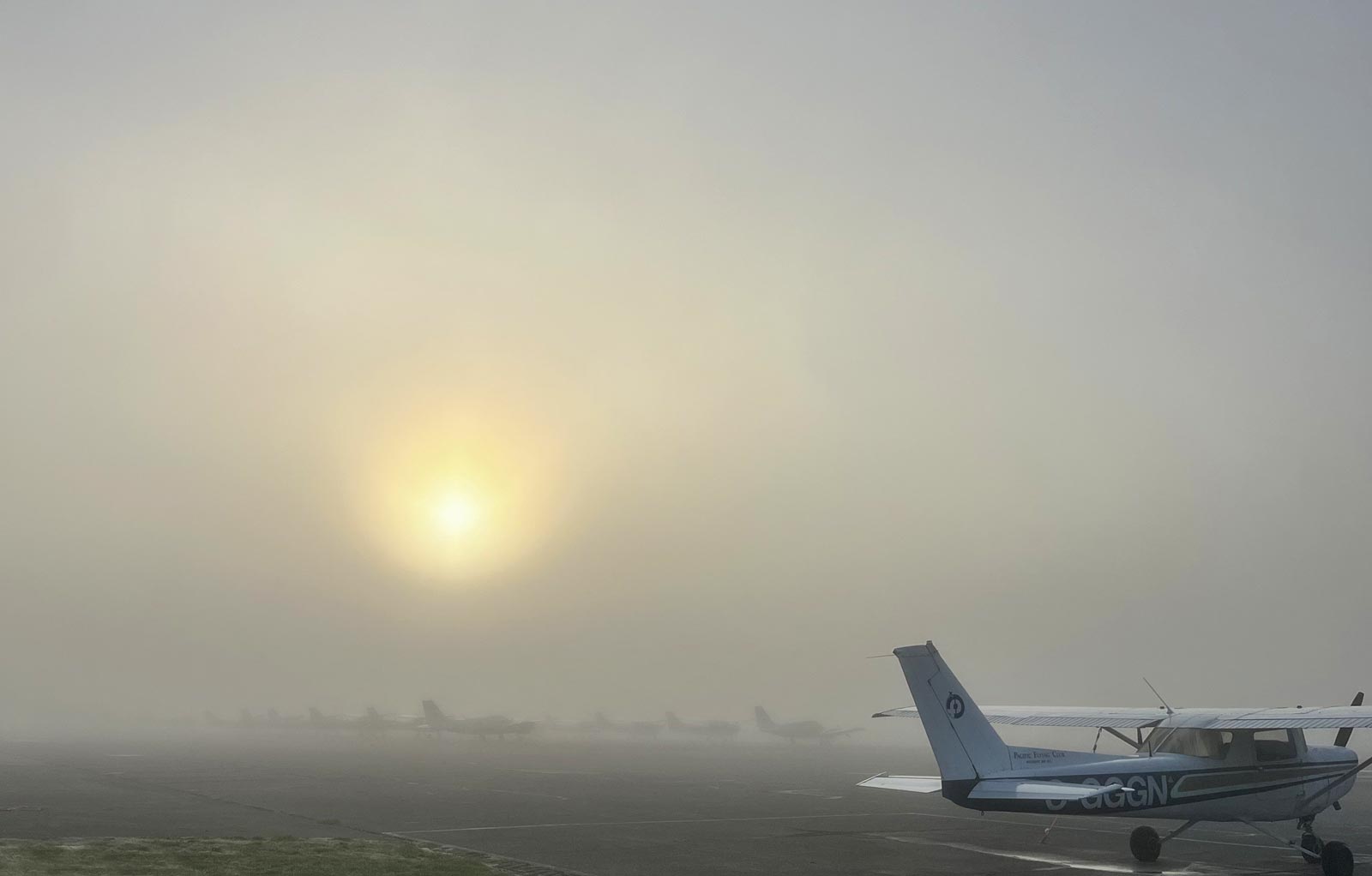
The morning sun is visible through thick fog at Boundary Bay Airport. Despite the sunshine, visibility remains limited, keeping PFC aircraft on the ground until

Nearly a century ago, a small aircraft company started in Wichita, Kansas with a straightforward plan: build a safe, affordable aeroplane that would let ordinary people learn to fly. That company was Cessna, and the idea worked better than anyone involved could have predicted. Today, the aircraft that carry the name are still the machines most student pilots first sit in — including the fleet on our ramp at Boundary Bay.
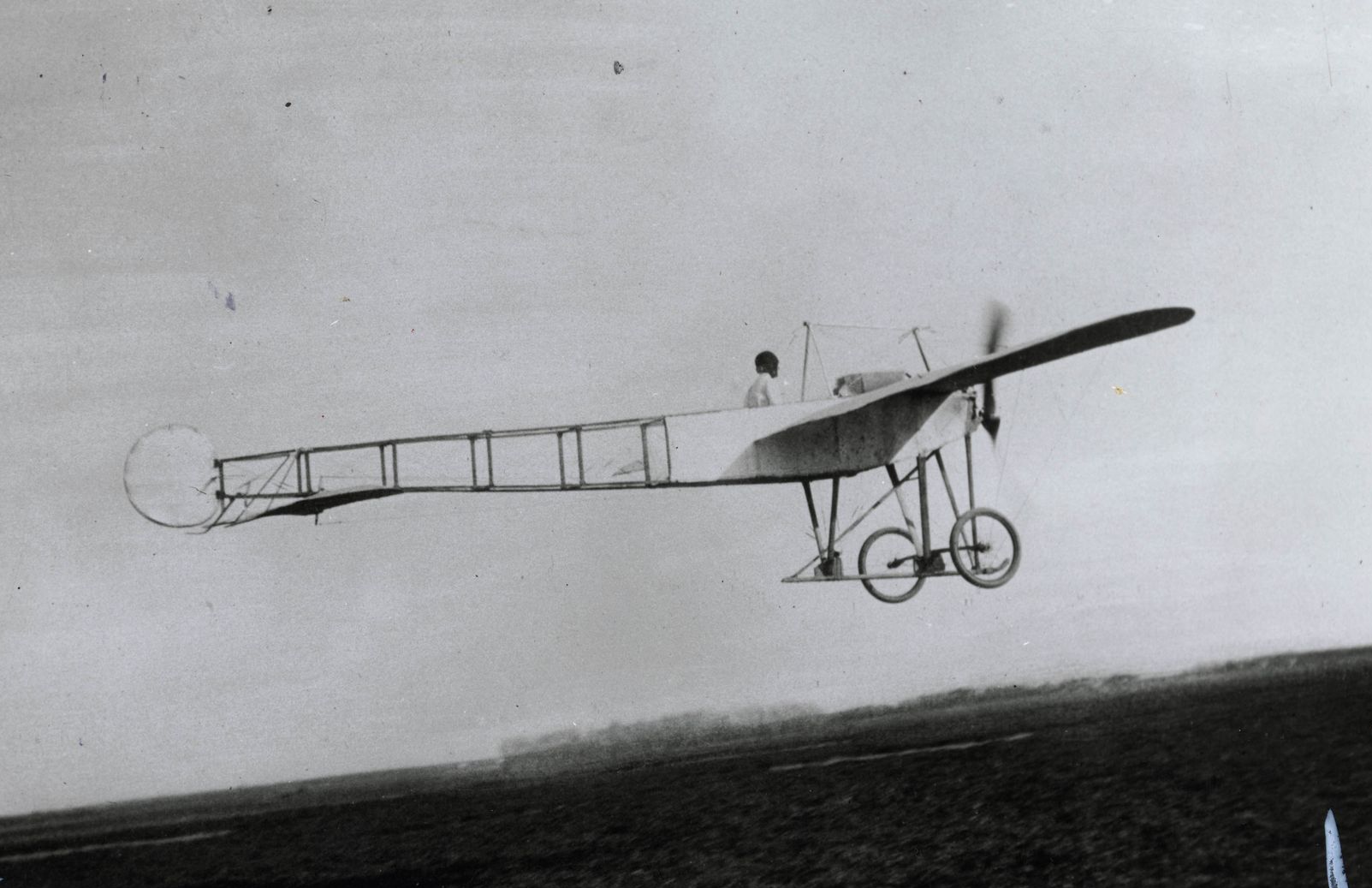
Clyde Cessna was a farmer with no formal engineering training. In 1911 he built his first aircraft, a spruce-and-linen monoplane he called the Silverwing, loosely modelled on the Blériot XI and powered by a modified 40-horsepower motorboat engine.
The early attempts did not go well. His first run ended in a ground loop, and a later attempt put the aircraft into a stand of trees during a turn. He kept rebuilding. In June 1911 he finally got the Silverwing into the air and back down in one piece, and by December of that year he completed a five-mile flight with a successful landing back at his point of departure — a genuine achievement for a self-taught pilot flying an aircraft he had designed himself.
When bankers refused to lend him the money to expand and build aircraft commercially, Cessna moved to Wichita, a city that was becoming the centre of American light aircraft manufacturing. He would spend the rest of his career there.
Cessna Aircraft traces its founding to 7 September 1927, when Clyde Cessna partnered with aviation entrepreneur Victor Roos to form the Cessna-Roos Aircraft Company. The partnership was short-lived. Roos resigned roughly a month later, sold his interest back to Cessna, and left to manage another Wichita manufacturer. By December the company had been renamed Cessna Aircraft Corporation — the name it would carry for the better part of the next century.
Ownership changed hands several times in the decades that followed. General Dynamics purchased the company in 1985, and Textron, Inc. acquired it in 1992. In March 2014, after Textron purchased Beechcraft and Hawker, Cessna ceased to operate as a standalone subsidiary and became one of three brands under Textron Aviation, where it remains today.
Through all of it, one design decision stayed constant. Cessna became known for high-wing light aircraft, with the wing mounted above the fuselage rather than below it. That configuration is still the visual signature of the brand, and it has practical consequences for training that pilots notice on their very first lesson: better downward visibility, easier ground handling, and a cabin you step down into rather than climb onto.
Cessna returned to commercial production in 1946 with the Model 120 and Model 140. These aircraft marked a real manufacturing shift. Rather than the hand-built tube-and-fabric construction that dominated before the war, Cessna moved to all-metal airframes built with production tooling, jigs, and dies.
The change mattered because it made light aircraft repeatable. Consistent tooling meant consistent aircraft, lower unit costs, and a supply chain that could support them for decades. That is a large part of why seventy-year-old Cessnas are still flying, and still economically sensible to maintain.
In the post-war era, Cessna was known as one of the “Big Three” American light aircraft manufacturers alongside Piper and Beechcraft — two of which now sit under the same corporate roof.
The Cessna 172 Skyhawk was introduced in 1956, which makes 2026 its seventieth year. More than 44,000 have been built, and it remains in production. No other aircraft in history comes close — the second most-produced aircraft ever built, the Ilyushin Il-2, finished at roughly 36,000 units and stopped rolling off the line in 1945.
The 172 is a four-seat, single-engine, high-wing aircraft with unremarkable performance figures, and that is precisely the point. It cruises at a modest speed, carries a useful but not generous load, and does nothing dramatic. What it does exceptionally well is behave predictably. It gives clear warning before a stall, recovers conventionally, tolerates imperfect landings, and does not punish a student for the small errors that are a normal part of learning.
Combine that with widespread parts availability, a deep maintenance knowledge base, and seventy years of accumulated training material, and you get an aircraft that is very hard to displace. Our Cessna 172 fleet includes both traditional-panel aircraft and G1000 glass-cockpit models, which lets students train on the avionics they are most likely to encounter in their careers.
The Cessna 152 arrived in 1977 as an update to the widely used 150. The most significant change was a more powerful engine, which improved both capability and reliability. Two seats instead of four, lower operating costs, and famously docile handling made it one of the most common training aircraft in the world.
For students working toward a Private Pilot Licence, the 152 is often the most sensible aircraft to build early hours in. It is forgiving in the circuit, honest in the practice area, and less expensive per hour than a 172 — which matters when you are budgeting a licence. Many students at Pacific Flying Club begin in the 152 and transition to the 172 as training progresses toward cross-country work and, for career-track students, the Commercial Pilot Licence.
It is reasonable to ask why a school would train new pilots on designs that predate almost every student who walks through the door. The answer is not sentiment.
Training aircraft have a different job than transport aircraft. They need to make the relationship between control input and aircraft response obvious, so a student can build a physical understanding of flight before layering on complexity. An aircraft that masks mistakes teaches less than one that shows them clearly and lets you correct them safely. The 152 and 172 do this well, and seven decades of operational data mean their behaviour is thoroughly documented and well understood.
They also fit the flying environment here. Boundary Bay sits under Vancouver’s terminal airspace with the Coast Mountains and the Gulf Islands within easy reach, which gives students controlled-airspace procedures, coastal weather, and terrain awareness in the same training area. Stable, straightforward aircraft leave more mental capacity for the parts of flying that actually take practice: radio work, airspace management, weather judgment, and decision-making.
Modern avionics have changed what the panel looks like, and our simulator training covers procedures and instrument work efficiently on the ground. But the airframe underneath is doing the same job it did in 1956.
Clyde Cessna’s goal was to put flying within reach of people who would otherwise never have had the chance. A century later, that is still roughly what happens on a first lesson: someone with no aviation background sits in a small high-wing aircraft, puts their hands on the controls, and discovers that flying is a learnable skill rather than a distant one.
You can see the full Pacific Flying Club fleet, including every 152 and 172 we operate. And if you have been considering flight training, a familiarization flight is a 30-minute introductory lesson with one of our instructors — the most direct way to find out whether this is something you want to pursue.
The morning sun is visible through thick fog at Boundary Bay Airport. Despite the sunshine, visibility remains limited, keeping PFC aircraft on the ground until
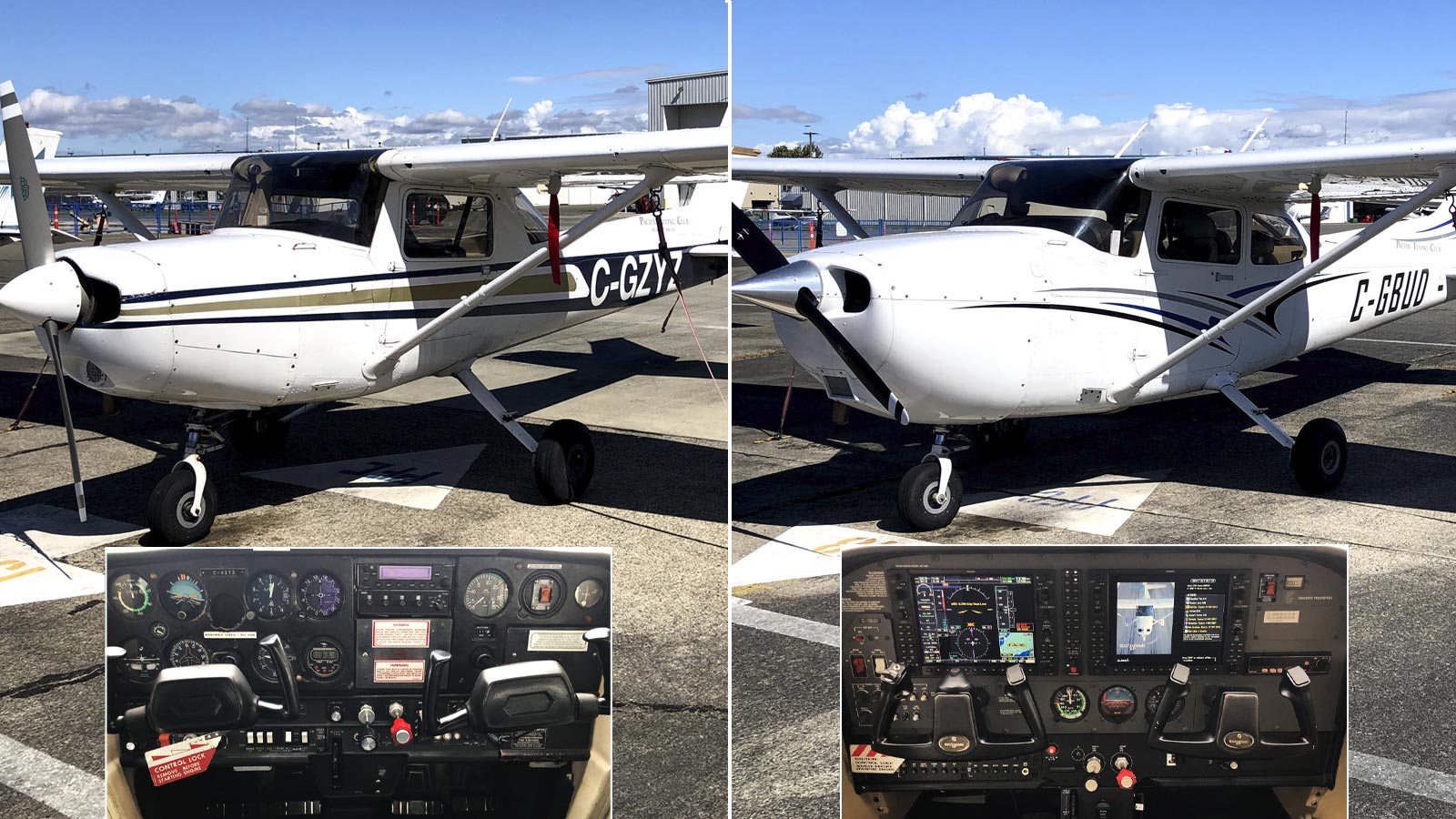
Cessna 152 and Cessna 172 at Pacific Flying Club, showing the differences in aircraft size, cabin design, and cockpit instrumentation. If you’re researching flight training,
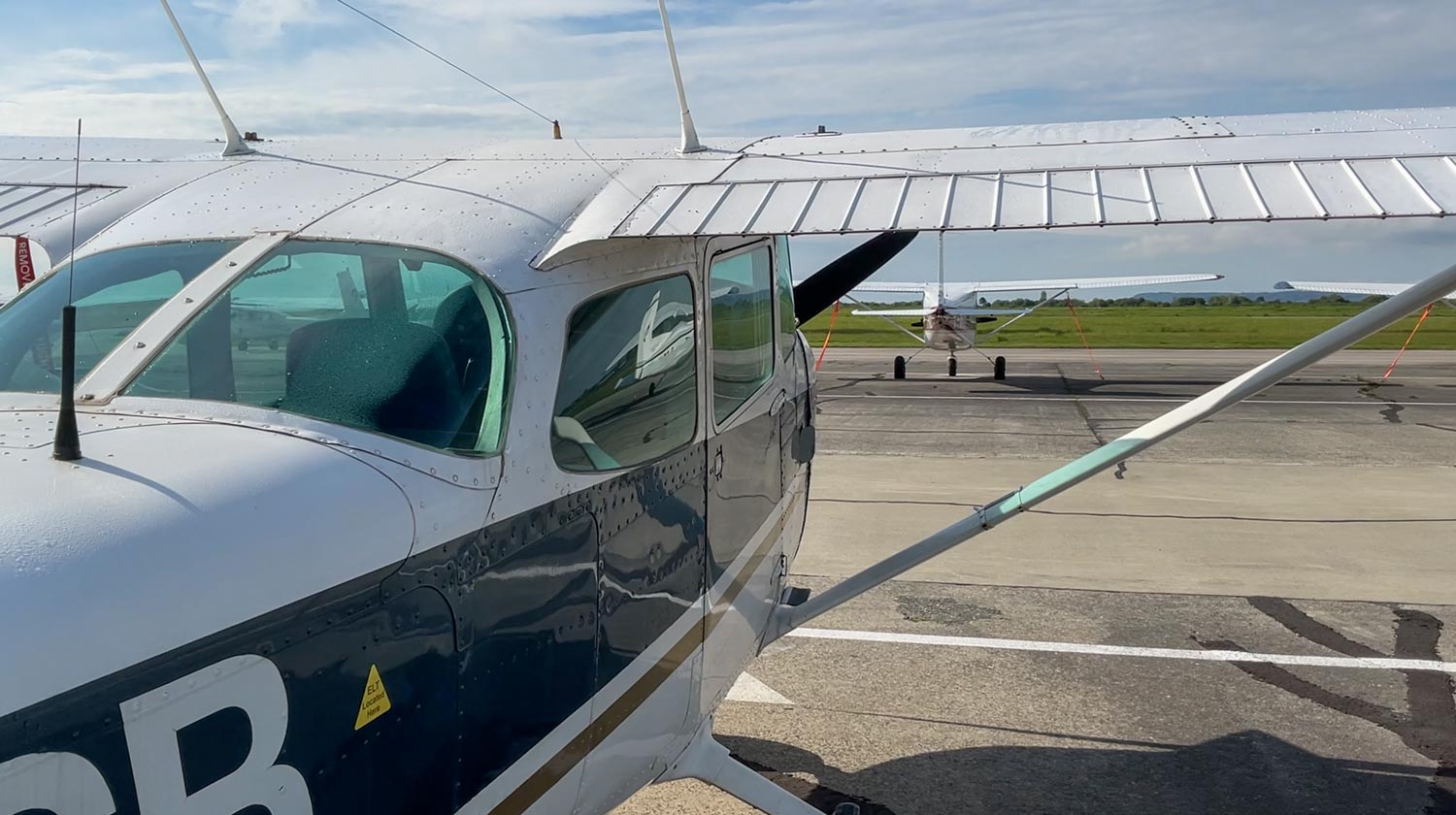
The strut running from the fuselage to the wing is what makes the Cessna 172’s high-wing design possible without a heavier, fully self-supporting cantilever structure.