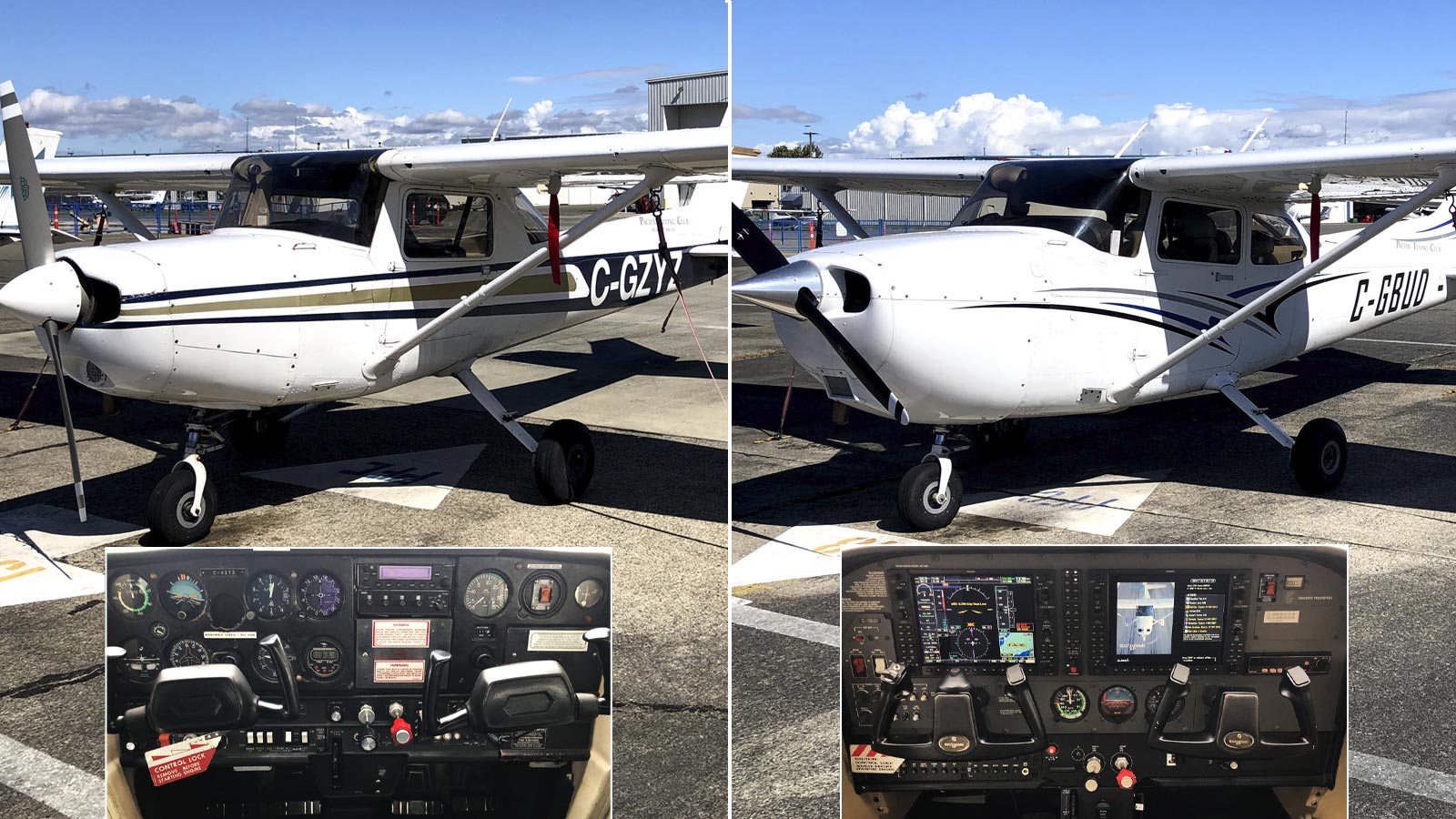
Walk into the cockpit of an older training aircraft, and you’ll usually see several round instruments spread across the panel. Airspeed, altitude, attitude, and heading are displayed on individual gauges that pilots learn to read and interpret quickly.
Step into a newer aircraft or modern simulator, and the panel can look very different. Large digital displays replace most of the individual instruments, presenting flight information, navigation maps, and system data on a few integrated screens. These modern panels are known as glass cockpits.
Understanding the difference between traditional instruments and glass cockpit systems is an important part of flight training. Each approach teaches valuable skills, and many training environments today expose pilots to both.
Traditional Flight Instruments: The Classic Six-Pack
For decades, pilots trained using the familiar six-pack layout, a group of six primary instruments arranged in two rows of three.
The six core instruments are:
- Airspeed indicator
- Attitude indicator
- Altimeter
- Turn coordinator
- Heading indicator
- Vertical speed indicator
Each instrument provides one piece of flight information. Pilots learn to scan between them continuously to understand the aircraft’s performance and attitude. This scanning technique builds strong situational awareness and remains a core skill in flight training.
Aircraft such as the Cessna 172 and Piper Seneca—both widely used in training fleets—often retain this traditional layout. Even as avionics technology advances, these instruments continue to provide a clear and reliable means of learning the fundamentals of flight.
Glass Cockpits: Integrated Digital Flight Displays
Modern aircraft increasingly replace mechanical gauges with digital displays. Instead of several small instruments, pilots see one or two large screens that combine flight information into a single integrated system.
Most glass cockpits organize information into two main displays:
- Primary Flight Display (PFD) showing attitude, altitude, airspeed, and heading
- Multi-Function Display (MFD) presenting navigation maps, weather data, terrain awareness, and engine information
By integrating information into a single display environment, glass cockpits can enhance situational awareness and simplify navigation management.
Many modern training aircraft and almost all airline flight decks use this type of technology. As a result, exposure to glass cockpit systems has become an important part of preparing pilots for advanced aircraft.
For a clear overview of how glass cockpit systems work, AOPA provides a useful explanation here: Glass Cockpit
Hybrid Cockpits: A Common Training Setup
Between traditional gauges and full glass cockpits lies a third configuration often found in training aircraft today. A hybrid cockpit combines classic round instruments with modern navigation avionics.
In this configuration, the primary flight instruments remain analog, while navigation and communication systems are upgraded with modern technology.
A hybrid cockpit may include:
- traditional airspeed, altitude, and attitude indicators
- GPS navigation systems
- digital autopilot systems
- electronic engine monitoring displays
Aircraft like the Piper Seneca used for multi-engine training often follow this approach. Students still learn the classic instrument scan while gaining experience with the digital tools used in modern aviation.
This combination helps bridge the gap between traditional training aircraft and fully digital cockpits.
Training with the ALSim ALX Simulator at Pacific Flying Club
Modern flight training increasingly uses advanced simulators to expose students to glass cockpit environments before they encounter them in complex aircraft. At Pacific Flying Club, one of these tools is the ALSim ALX simulator.
The ALX is designed to replicate the cockpit environment of modern turbine aircraft using a full glass cockpit layout. Instead of round gauges, the simulator uses large digital displays that present flight data, navigation information, and aircraft systems in an integrated format similar to modern airline aircraft.
Because of this design, the simulator allows students to become familiar with glass cockpit workflow and procedures in a controlled training environment.
The ALX simulator is commonly used for practicing:
- instrument flight procedures
- IFR navigation and approaches
- cockpit management and workload
- abnormal and emergency scenarios
Simulators allow instructors to introduce complex situations safely. Weather conditions, system failures, or challenging instrument approaches can be practiced repeatedly without the risks associated with real aircraft.
Pacific Flying Club provides a detailed discussion of this training device in this interview with instructor Marcel Gimenez.
For students who begin their training on traditional instruments, simulator sessions like these provide valuable exposure to modern digital flight displays and prepare them for more advanced aircraft.
Why Traditional Instruments Still Matter
Even though glass cockpits are becoming more common, many instructors still value training on traditional instruments. Mechanical gauges encourage pilots to build disciplined instrument scanning habits and interpret flight information without relying on automation.
These skills remain essential. Technology can fail, displays can become unreliable, and pilots must always be able to control the aircraft using fundamental flying principles.
Understanding how the aircraft behaves — rather than simply reading digital data — is a key part of becoming a confident and capable pilot.
Technology Changes, Fundamentals Do Not
Cockpit technology has evolved dramatically over the past two decades. Digital flight displays now combine navigation, weather, traffic, and aircraft performance data into a few integrated screens. Simulators such as the ALSim ALX at Pacific Flying Club expose students to these environments early in their training.
At the same time, the fundamentals of flight remain unchanged. Pilots still control the aircraft through attitude, airspeed, and power. Whether that information appears on round gauges or digital displays, understanding how an aircraft moves through the air is what ultimately matters.
For student pilots, the goal is not to choose between traditional instruments and glass cockpits. The goal is to become comfortable with both. A pilot who understands the fundamentals and can adapt to modern avionics will be prepared to fly a wide range of aircraft and handle the evolving technology of aviation.